Downtown · Union Station
A railroad palace on Market Street
For decades more trains passed through this station than almost anywhere else. The passengers are long gone, but the stone tower, the vaulted hall and the great iron shed remain.
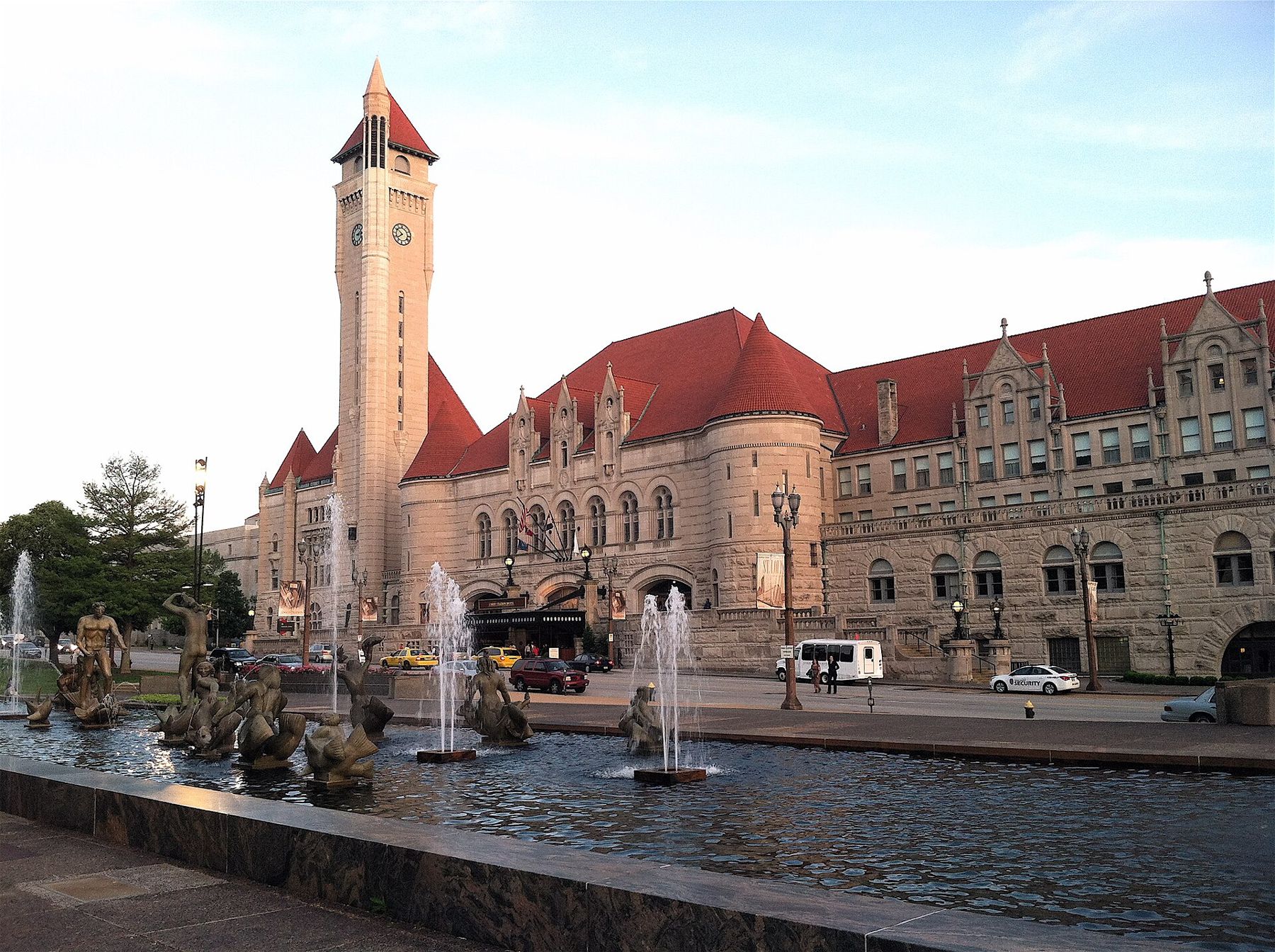
Walk west on Market Street from downtown and a stone tower rises at the end of the view, its clock face above a steep red roof. This is Union Station, opened in 1894, when St. Louis was one of the great railroad cities of the country and needed a front door to match. It no longer serves passenger trains, but the building still stops people on the sidewalk.
The head house
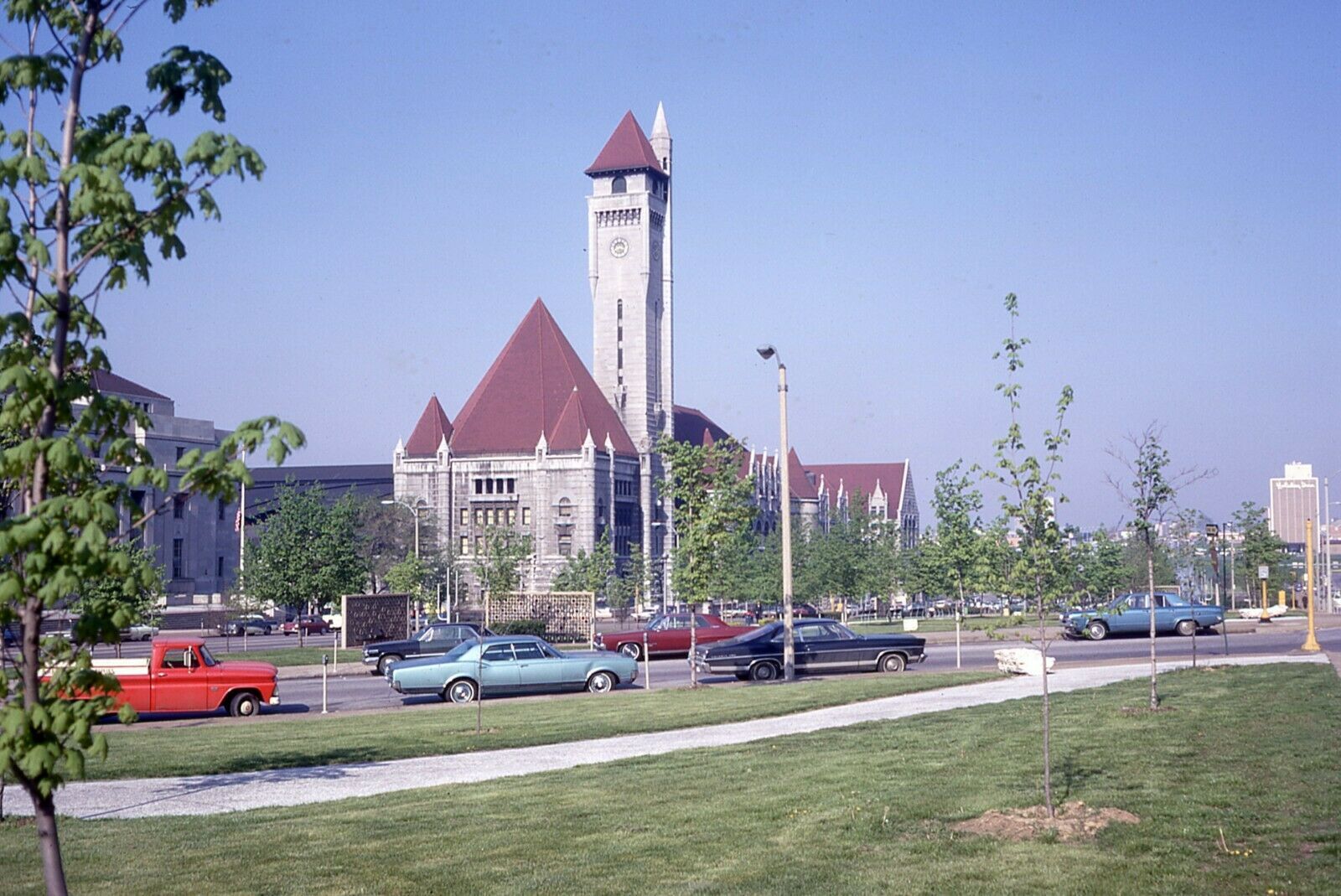
The station has two parts. Facing Market Street is the head house, a long building of gray stone with turrets, gables, round arches and a tower with a clock. It was designed by the architect Theodore Link in a heavy Romanesque style, with touches borrowed from the walled towns of medieval France. Here passengers bought tickets, waited, ate and checked their bags.
Inside, the Grand Hall is the room everyone comes to see. Its barrel-vaulted ceiling is covered in gilded plasterwork and stencilling, with arches springing from heavy columns. Look for the great stained glass window over the main entrance on the inside, showing three women who stand for New York, St. Louis and San Francisco, the station's place on a line from coast to coast.
The hall was the station's waiting room and its showpiece, built to impress travelers stepping off a long ride and to tell them they had arrived somewhere that mattered. The scale is the point: stand by the wall and look the length of the vault, and the room seems to keep going. Afternoon light through the high windows picks out the gold.
Near the hall's old entrance is a curved stone archway with an acoustic trick. Two people standing at opposite ends of the arch, facing the stone, can hear each other whisper across the gap. It is known as the whispering arch, and children love it.
The train shed
Behind the head house, the train shed spread over the tracks: a vast iron roof on slender trusses, wide enough to cover dozens of tracks and built to keep the weather off thousands of passengers a day. When it was finished it was among the largest train sheds ever built. The truss design, by the engineer George Pegram, let the roof span great widths with light members, and you can still read the crisscross of iron from inside.
At the station's peak, in the years around the world wars, a great many trains a day used its tracks. Troops came through in great numbers. After the war, passenger rail declined, and the last regular passenger train left the station in 1978. For several years the building stood empty under its great roof, its tracks pulled up and its hall dark, and there was talk of what might be lost. Trains still run past on the main lines nearby, and the long-distance passenger trains that serve the city today stop at a newer, smaller station a short way east.
Mile 0.8Fountains, bronze and a mile of grassWhat it is now
The station was reopened in 1985 as a mix of shops, restaurants and lodging, one of the largest railroad station reuse projects of its time. It has been reworked more than once since. Today the head house and the shed hold a changing mix of businesses, attractions and event spaces, with open-air space under part of the old shed.
Because what is inside changes, the best plan is to come for the architecture and check before you go for anything else. The Grand Hall is the part to see. On busy days the building is crowded, and event days around the downtown stadiums and arenas fill it further.
Aloe Plaza and the Meeting of the Waters
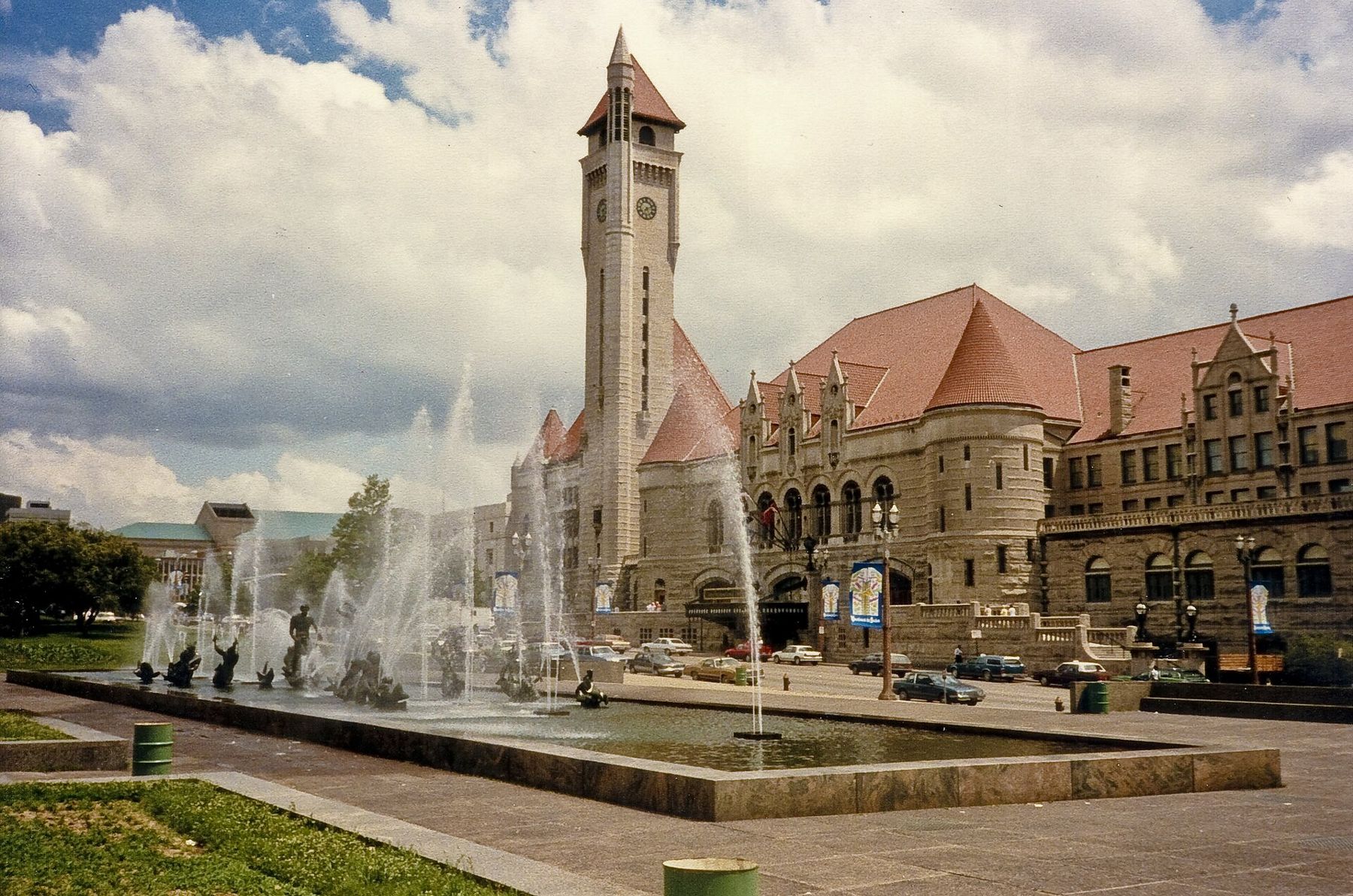
Across Market Street from the station, Aloe Plaza holds one of the city's great fountains. The Meeting of the Waters, by the Swedish sculptor Carl Milles, was dedicated in 1940. Its bronze figures, a male and a female surrounded by water creatures and spouting fish, stand for the meeting of the Mississippi and Missouri rivers just north of the city. The figures are playful rather than solemn, and in summer the jets fill the long pool with spray.
The plaza is part of the long Gateway Mall that runs east toward Citygarden and the Old Courthouse. From the fountain you can look back east along the mall toward downtown, with the station's tower behind you.
West along Market Street
West of the station, the city changes. The land along the railroad tracks between here and Grand Boulevard was once Mill Creek Valley, a crowded, mostly Black neighborhood of homes, churches and businesses. It was demolished beginning in 1959 under urban renewal, and thousands of residents were displaced. Much of the land became highways, rail yards and broad empty lots before newer buildings went up. Nothing much marks it on the ground, which is part of the story.
Farther along, Market Street gives way to the edge of midtown, where the arts blocks of Grand Center start. It is a long walk; most people take MetroLink or drive.
Getting here
The Union Station MetroLink station sits at the southern edge of the train shed, so you step off light rail into the old railroad grounds. Other lines and buses connect nearby. If you want the whole axis, this is a good midpoint between the Arch and the park; the MetroLink ride west from here reaches Grand and the Central West End in a few stops.
Spring and fall are pleasant for walking around the building and plaza. After dark the tower is lit, and it stands out against the sky from far down Market Street. Check what is on, and when, before you go.